How to succeed:
• Cloud certifications from AWS or Google will be advantageous
• 4 years’ experience in cloud related operations or implementation
• Strong knowledge and experience in Devops automation, containerisation and orchestration using tools
• Strong scripting skills e.g. Python, Bash, JavaScript, Ruby
• Strong understanding and practice Agile/Lean projects SCRUM, KANBAN etc.
• Strong understanding of virtualization and networking
• Experience with highly scalable distributed systems
• Experience with infrastructure and application monitoring, especially in cloud native monitoring solutions
• Demonstrate strong ability in analytical & problem solving skills
• Familiar with Site Reliability Engineering practices and methodologies will be advantageous
• Cloud computing deployment and management experience – AWS, Google
• Knowledge in open source technologies and configurations, Machine Learning technologies and environments
• Breadth of knowledge in OS, networking, distributed computing, cloud computing
• Strong interpersonal & management skills to succeed in a highly collaborative and cross-functional team environment
Author: fire_horse
-
Senior DevOps Engineer
-
DevOps Engineer
Other Responsibilities include:
Translating non-functional requirements of Development, Security, and Operations architectures into design that can be implemented using the chosen set of software for the project.
Ownership of technical design and implementation for one or more software stacks of the DevSecOps team.
Design and implementation of the distributed code repository.
Implementing automation pipelines to support code compilation, testing, and deployment into the software components of the entire solution.
Integrating the monitoring of all software components in the entire solution, and data mine the data streams for actionable events to remediate issues.
Implement configuration management pipelines to standardize environments.
Integrate DevSecOps software with credentials management tools.
Create non-functional test scenarios for verifying the DevSecOps software setup.Qualifications
The DevOps Engineer is an experienced position for applicants with at least 3 years of relevant working experience. Successful applicant will be a member of the DevSecOps team, tasked with design and implementation of automation pipelines with new tools. The applicant will be expected to be explorative and independent with minimal supervision from the manager.Critical Success Factors
At least 3 years of relevant working experience in DevSecOps, Task Automation, or GitOps.
Demonstrated proficiency installation, configuration, or implementation in one or more of the following software.
Jenkins, Azure DevOps, Bamboo, or software of similar capability.
GitHub, GitLab, or software of similar capability.
Jira, Asana, Trello, or software of similar capability.
Ansible, Terraform, Chef Automate, or software of similar capability.
Flux CD, or software of similar capability.
Any test automation software.
Any service virtualization software.
Operating Software administration experience for Ubuntu, Debian, Alpine, RHEL.
Technical documentation writing experience.
DevOps Engineering certification for on-premises or public cloud is advantageous.
Experience with work planning and effort estimation is an advantage.You will also have opportunities to hone your functional skills and expertise in an area of specialization. We offer a variety of formal and informal training programs at every level to help you acquire and build specialized skills faster. Learning takes place both on the job and through formal training conducted online, in the classroom, or in collaboration with teammates. The sheer variety of work we do, and the experience it offers, provide an unbeatable platform from which to build a career.
-
Deactivated all users in Appian environment, how to fix?
Background
As part of a user story to Deactivate Users Who Have Not Logged In Recently, we set the value for Idle User Deactivation Duration (Days) as 1 day.
This caused all the users to be deactivated after 1 days of inactivity including system administrator accounts.
We were not able to login using any of the user accounts as a result.Fix
- Reached out to Appian support about this issue
- Appian support provided a zip file called “ASTM_Appian_Support_Tools_Manager.zip (10.54 MB)”
- Download the attached file “ASTM_Appian_Support_Tools_Manager.zip” and unzip it into /opt/appian/latest/_admin/_scripts
- Some next steps to follow:
3.1. Go into the folder: “cd /_admin/_scripts”
3.2. Enable permission: “chmod +x ./executeAppianSupportScript.sh”
3.3. Run the following command: “./executeAppianSupportScript.sh reactivateusers –usernames site-admin”
cd  /opt/appian/latest/_admin/_scripts
chmod +x ./executeAppianSupportScript.sh
./executeAppianSupportScript.sh reactivateusers --usernames site-admin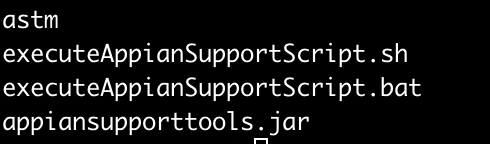
Inside the ASTM_Appian_Support_Tools_Manager.zip 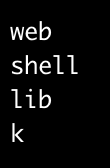
Inside the astm directory -
How to check the appian product license expiry date
/opt/appian/latest/server/_bin/k/linux64
I am getting k3.lic as the output when I run k.exe under /server/_bin/k/linux64. I know that it indicates that the license is invalid and it might have been expired. But there are other factors which can make a license invalid.
The license for this environment is invalid for at least one of the following reasons:
There was a change in the operating system.
There was a change in the CPU count.
The FQDN was changed.
The license expired.
More than one hostname resolves to the local network IP of the machine where this license is installed
So I want to know that if the license expiry is the reason in my case. How can I check the expiry date for the license? -
git-stash
https://git-scm.com/docs/git-stash#:~:text=DESCRIPTION,to%20match%20the%20HEAD%20commit.
git rebase -i HEAD~2 git push -f -
Automation Testing Tools/Frameworks
Cucumber
Selenium
Appium
http://appium.io/docs/en/writing-running-appium/web/mobile-web/
Robot Framework
-
L1-L6 Engineers
L1 engineers are entry level engineers who can complete assigned engineering tasks under guidance.
L2 engineers are competent individual contributors who can work comfortably with engineering tools, run systems in production, prioritise engineering tasks for themselves, and complete them independently.
L3 engineers are fully proficient individual contributors who can provide technical leadership to teams. These engineers can devise the architecture of the projects, break it down into engineering tasks, and make rapid progress on the tasks.
L4 engineers are prolific individual contributors who can proactively identify, initiate, and coordinate worthwhile engineering projects for the organisation to pursue. These engineers have deep expertise in at least one technical domain and are comfortable working with people across the organisation.
L5 engineers provide critical engineering leadership of the organisation. These engineers can create a long term vision for what the organisation should be building towards and structure the groundwork for building projects to get there.
L6 engineers are leading experts in their field of technical expertise. These engineers exert strong technical influence and leadership in the engineering field and community. They contribute to the organisation by providing deep technology expertise to develop and implement major high impact tech initiatives, provide technical leadership and mentorship to other engineers, and serve as talent anchor for the organisation to attract other tech talent.