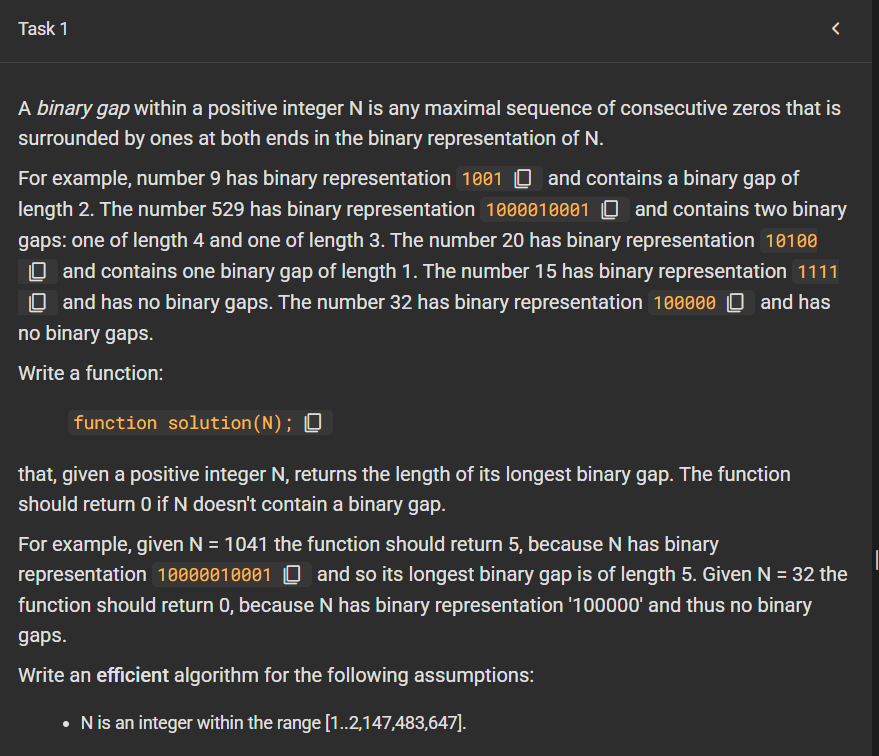
A binary gap within a positive integer N is any maximal sequence of consecutive zeros that is surrounded by ones at both ends in the binary representation of N. For example, number 9 has binary representation 1001 content_copy and contains a binary gap of length 2. The number 529 has binary representation 1000010001 content_copy and contains two binary gaps: one of length 4 and one of length 3. The number 20 has binary representation 10100 content_copy and contains one binary gap of length 1. The number 15 has binary representation 1111 content_copy and has no binary gaps. The number 32 has binary representation 100000 content_copy and has no binary gaps. Write a function: function solution(N); content_copy that, given a positive integer N, returns the length of its longest binary gap. The function should return 0 if N doesn’t contain a binary gap. For example, given N = 1041 the function should return 5, because N has binary representation 10000010001 content_copy and so its longest binary gap is of length 5. Given N = 32 the function should return 0, because N has binary representation ‘100000’ and thus no binary gaps. Write an efficient algorithm for the following assumptions: N is an integer within the range [1..2,147,483,647].
// you can write to stdout for debugging purposes, e.g.
// console.log('this is a debug message');

function solution(N) {
  const binary = N.toString(2);
  let maxGap = 0;
  let currentGap = 0;
  let counting = false;

  for (let char of binary) {
    if (char === "1") {
      if (counting) {
        maxGap = Math.max(maxGap, currentGap);
      }
      counting = true;
      currentGap = 0;
    } else if (counting) {
      currentGap++;
    }
  }

  return maxGap;
}