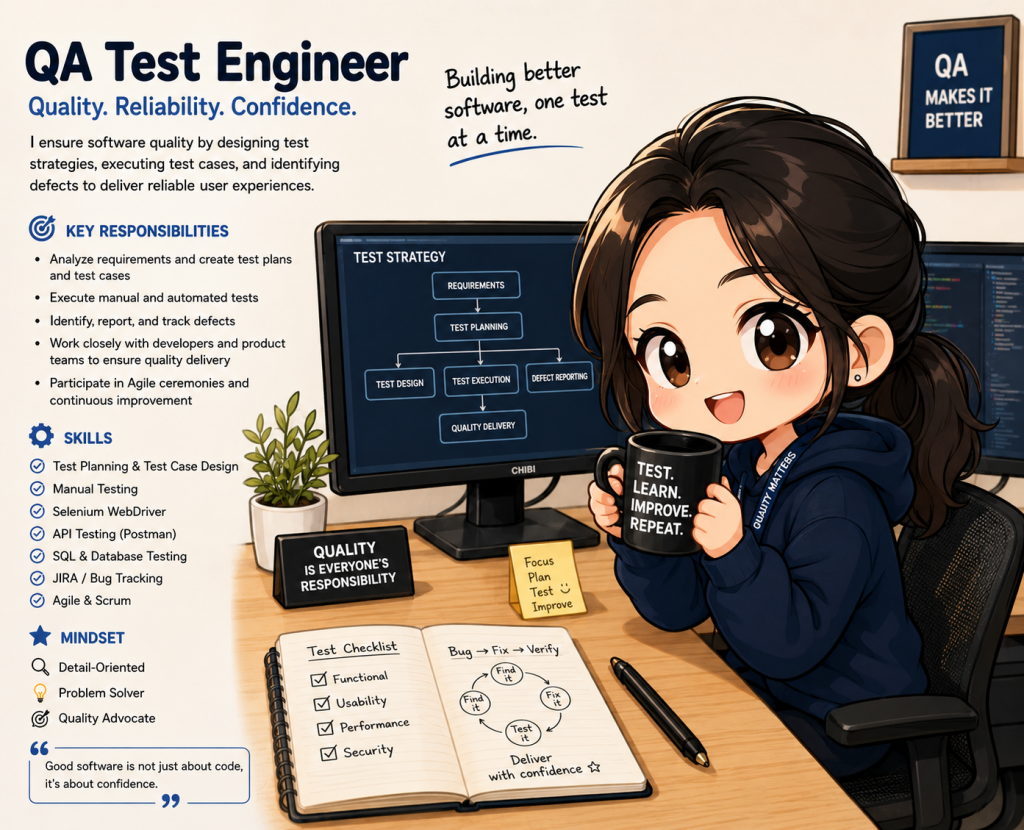
We are looking for a skilled and detail-oriented QA Test Engineer to join an Agile product team. The ideal candidate will take ownership of end-to-end quality assurance activities across the full SDLC, ensuring high-quality delivery in a complex distributed system environment.
Key responsibilities
Work as an embedded QA engineer within Agile/Scrum teams, owning end-to-end testing for team applications
Participate in requirements analysis, story refinement, sprint planning, and design discussions
Design, execute, and maintain test cases and scenarios based on business requirements and acceptance criteria
Perform functional, integration, regression, exploratory, and end-to-end testing across multiple systems
Validate integrations and backend services using REST API testing tools (e.g. Postman)
Create and maintain test data across multiple environments
Document test results with evidence, logs, screenshots, and traceability
Conduct root cause analysis and work with developers to resolve defects efficiently
Manage defects through full lifecycle: logging, tracking, retesting, and closure
Support release validation and post-production verification
Collaborate with cross-functional teams, business users, and external vendors
Communicate testing progress, risks, blockers, and quality status to stakeholders
Contribute to automation testing initiatives using Playwright where applicable
Support continuous improvement of QA processes, standards, and best practices
Mandatory skills
Proven experience as a QA Test Engineer, QA Analyst, or Software Test Engineer in Agile/Scrum
Strong hands-on manual testing and exploratory testing experience
Experience in test case design, execution, and defect management
Strong understanding of end-to-end business processes and system integration testing
Hands-on REST API testing using Postman or similar tools
Experience testing web-based applications and backend services
Good understanding of SDLC, STLC, and Agile methodologies
Strong analytical, troubleshooting, and root cause analysis skills
Jira experience; Xray exposure is an advantage
Ability to work independently with strong ownership and accountability
Excellent communication and stakeholder management skills
Preferred skills
Experience in Banking, FinTech, or Investment Management domains
Exposure to Playwright or other automation frameworks
Knowledge of CI/CD pipelines and Git
Experience in DevOps environments
ISTQB Foundation Certification
Agile or Scrum certifications
Soft skills
Self-driven and proactive mindset
Strong attention to detail and organisational skills
Team player with a collaborative attitude
Strong sense of ownership and responsibility
Ability to manage changing priorities effectively
Reliable, structured, and quality-focused approach
Most candidates fail interviews for one simple reason:
They know the answer in their head, but they deliver it in a messy, unstructured way.
One minute they’re talking about the problem, then suddenly jumping into technical details, then ending without explaining the actual result. Interviewers are left trying to connect the dots themselves.
This is where structured frameworks become incredibly powerful.
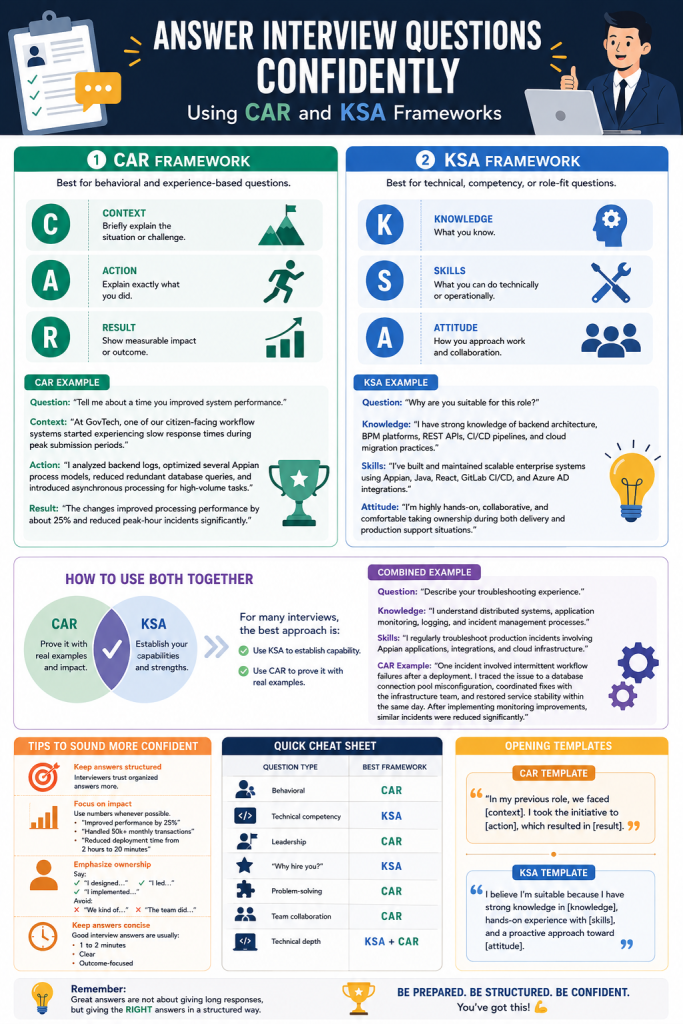
Two of the best frameworks I’ve used for technical and corporate interviews are:
CAR Framework
KSA Framework
These frameworks help you:
Stay calm during interviews
Structure answers clearly
Sound more professional
Demonstrate impact confidently
Avoid rambling
Whether you’re interviewing for software engineering, DevOps, Appian, QA, SRE, or data roles, these frameworks work surprisingly well.
The CAR Framework
The CAR framework is ideal for behavioral and experience-based questions.
It stands for:
Letter
Meaning
C
Context
A
Action
R
Result
The beauty of CAR is that it forces your answer into a logical narrative.
1. Context
Start by explaining the situation briefly.
You are setting the stage for the interviewer.
Good context answers:
What was the challenge?
What system/project/team was involved?
Why was it important?
Keep this part short.
Weak Example
“So we had this issue and people were discussing things and there were many problems…”
Strong Example
“At GovTech, one of our citizen-facing workflow systems began experiencing slow response times during peak submission periods.”
Clear. Specific. Professional.
2. Action
This is the most important section.
Explain:
What YOU did
Your technical contribution
Your decision-making process
Tools or technologies used
Avoid overusing “we.”
Interviewers want to know your contribution.
Weak Example
“We optimized the system.”
Strong Example
“I analyzed backend logs, optimized database queries, redesigned several Appian process flows, and implemented asynchronous processing for high-volume tasks.”
Now the interviewer can actually see your capability.
3. Result
Most candidates forget this part entirely.
Never end an answer without measurable impact.
Examples:
Performance improvements
Cost savings
Reduced incidents
Faster deployments
Better user experience
Increased scalability
Strong Result Statements
“Improved system performance by 25%”
“Reduced deployment time from 2 hours to 20 minutes”
“Handled over 50k monthly transactions reliably”
Numbers make your story believable.
Full CAR Example
Interview Question
“Tell me about a time you solved a production issue.”
Answer
“At GovTech, one of our workflow systems experienced intermittent failures during peak traffic periods. I investigated application logs and traced the issue to inefficient database calls and thread contention within several backend services. I optimized the queries, adjusted thread pool configurations, and implemented monitoring alerts to detect recurrence early. As a result, system stability improved significantly and production incidents during peak periods were reduced.”
Notice how:
The answer is structured
It flows naturally
It demonstrates ownership
It ends with impact
That’s why CAR works.
The KSA Framework
KSA stands for:
Letter
Meaning
K
Knowledge
S
Skills
A
Attitude
This framework works best for:
Technical competency questions
“Why should we hire you?”
Role-fit discussions
Leadership and collaboration questions
1. Knowledge
This is what you understand conceptually.
Examples:
Cloud architecture
CI/CD practices
Networking fundamentals
BPM systems
Distributed systems
Data modeling
Example
“I have strong knowledge of backend architecture, REST APIs, CI/CD pipelines, and cloud migration practices.”
2. Skills
This is what you can actually do.
Examples:
Build systems
Troubleshoot production issues
Automate deployments
Write code
Create dashboards
Develop APIs
Example
“I’ve built scalable enterprise systems using Java, React, Appian, GitLab CI/CD, and Azure AD integrations.”
3. Attitude
This is the most underrated section.
Companies hire people they can trust under pressure.
Attitude includes:
Ownership
Collaboration
Communication
Learning mindset
Reliability
Example
“I’m highly hands-on, proactive during incidents, and comfortable collaborating across engineering and business teams.”
Full KSA Example
Interview Question
“Why are you suitable for this role?”
Answer
“I believe I’m a strong fit because I have solid knowledge of backend systems, cloud infrastructure, and enterprise workflow platforms. I’ve built and maintained scalable applications using Appian, Java, React, and GitLab CI/CD pipelines. In terms of attitude, I’m highly collaborative, adaptable, and comfortable taking ownership of both delivery and production support responsibilities.”
Clean. Professional. Structured.
Combining CAR + KSA
The best interview answers often combine both frameworks.
Example Question
“Describe your troubleshooting experience.”
Combined Answer
“I have strong knowledge of distributed systems, application monitoring, and incident management practices. In my previous role, I regularly handled production troubleshooting across Appian applications and cloud infrastructure. One incident involved intermittent workflow failures after a deployment. I traced the issue to a database connection pool misconfiguration, coordinated fixes with the infrastructure team, and restored service stability within the same day. After implementing monitoring improvements, similar incidents were significantly reduced.”
This approach:
Shows technical depth
Demonstrates experience
Proves real-world execution
Why These Frameworks Work So Well
Most interviewers are evaluating three things:
Can you communicate clearly?
Can you solve problems?
Can you deliver impact?
CAR and KSA naturally answer all three.
They also help reduce nervousness because you already know the structure before answering.
Instead of improvising everything, your brain simply fills in the framework.
Common Interview Mistakes These Frameworks Prevent
1. Rambling
Without structure, candidates talk too much and lose focus.
2. Missing Results
Many people explain what they did but never explain why it mattered.
3. Weak Ownership
Saying “we” repeatedly makes your contribution unclear.
4. Sounding Unprepared
Structured answers automatically sound more professional.
Practical Tips for Better Interview Answers
Keep answers concise
Aim for:
1 to 2 minutes per answer
Clear beginning, middle, and end
Use metrics whenever possible
Examples:
25% performance improvement
50k+ monthly transactions
40% faster deployment pipeline
Reduced incidents by half
Metrics make you memorable.
Focus on YOUR contribution
Instead of:
“The team built…”
Say:
“I designed…” “I implemented…” “I led…”
Practice out loud
Reading answers silently is not enough.
The real challenge is verbal delivery.
Practice:
Speaking slowly
Structuring naturally
Avoiding filler words
Maintaining confidence
Final Thoughts
Technical knowledge alone is rarely enough to succeed in interviews.
The candidates who stand out are usually the ones who:
Communicate clearly
Structure answers well
Demonstrate ownership
Show measurable impact
Frameworks like CAR and KSA won’t magically get you hired.
But they dramatically improve how interviewers perceive your experience and confidence.
And in competitive tech interviews, that difference matters more than most people realize.
Most people use the internet every day without ever seeing what’s actually happening under the hood. We click links, send messages, stream videos—and everything just works.
But beneath that simplicity lies a constant flow of packets: tiny chunks of data moving across networks at incredible speed.
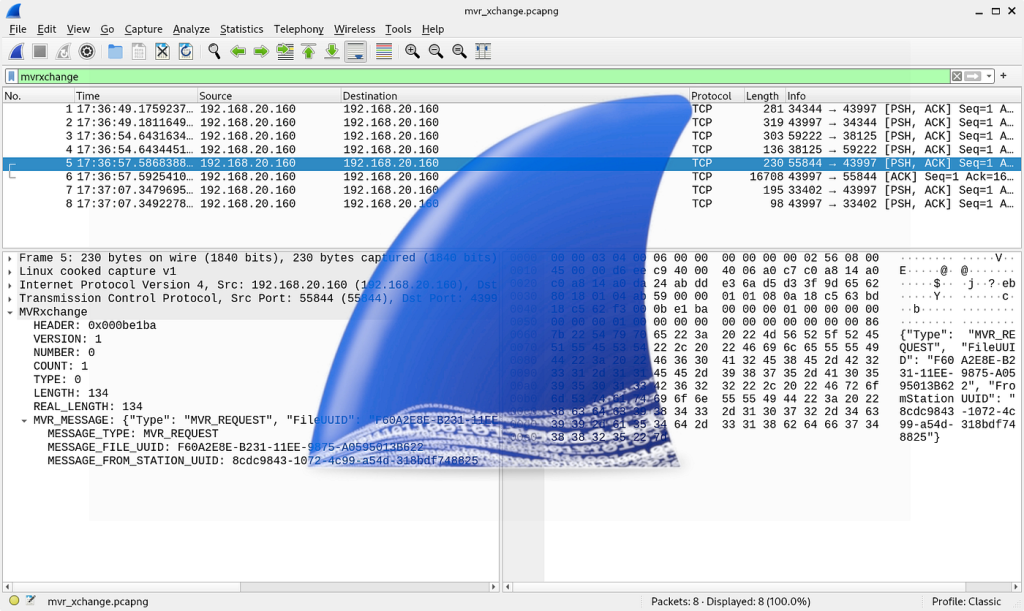
If you’ve ever wanted to see that invisible layer, Wireshark is where things get interesting.
What is Wireshark?
Wireshark is a network protocol analyzer—a tool that lets you capture and inspect the data traveling across a network in real time.
Think of it as:
A microscope for network traffic
A debugger for connectivity issues
A truth-teller when systems behave strangely
It shows you exactly what data is being sent, where it’s going, and how it’s structured.
Why Wireshark Matters
At first glance, Wireshark can feel overwhelming. Thousands of packets, cryptic protocols, endless columns.
But once you understand it, it becomes incredibly powerful.
🔍 Troubleshooting Network Issues
When something breaks, logs don’t always tell the full story. Wireshark shows:
Failed connections
Retransmissions
DNS issues
Latency bottlenecks
Instead of guessing, you see the problem.
🔐 Security Analysis
Wireshark is widely used in cybersecurity to:
Detect suspicious traffic
Identify data leaks
Analyze malware communication
Inspect unencrypted credentials
It’s not a hacking tool—but it’s often used to understand how attacks work.
📡 Learning How the Internet Works
If you want to truly understand networking, there’s no better teacher.
You can observe:
TCP handshakes
HTTP requests and responses
TLS encryption flows
DNS lookups
It turns abstract concepts into something tangible.
A Simple Example
Let’s say you open a website.
Behind the scenes, Wireshark will show something like:
Your computer sends a DNS request to resolve the domain
A TCP handshake is established (SYN → SYN-ACK → ACK)
An HTTP or HTTPS request is sent
The server responds with data packets
Your browser reconstructs everything into a webpage
What feels instant is actually a series of precise, structured steps.
Key Features That Make Wireshark Powerful
📊 Deep Packet Inspection
Wireshark doesn’t just capture packets—it decodes them into human-readable formats.
🔎 Powerful Filtering
Instead of drowning in data, you can filter traffic like:
http
dns
ip.addr == 192.168.1.1
tcp.port == 443
This turns chaos into clarity.
⏱️ Real-Time Capture
You can watch traffic as it happens, which is incredibly useful for debugging live systems.
The Learning Curve (and Why It’s Worth It)
Let’s be honest—Wireshark is not beginner-friendly.
The interface can feel intimidating:
Thousands of packets scrolling
Protocols you’ve never heard of
Hex data everywhere
But once you learn:
Basic networking (TCP/IP, DNS, HTTP)
How to filter traffic
How to follow streams
…it becomes one of the most valuable tools in your toolkit.
Who Should Learn Wireshark?
Site Reliability Engineers (SREs)
Backend engineers
Security analysts
DevOps engineers
Curious developers
If you work with systems, networks, or APIs—this tool will give you an edge.
Final Thoughts
Wireshark changes how you see the internet.
It takes something invisible and makes it observable. It turns guesswork into evidence. It forces you to understand how things actually work.
And once you’ve used it, you’ll never look at a “simple” web request the same way again.
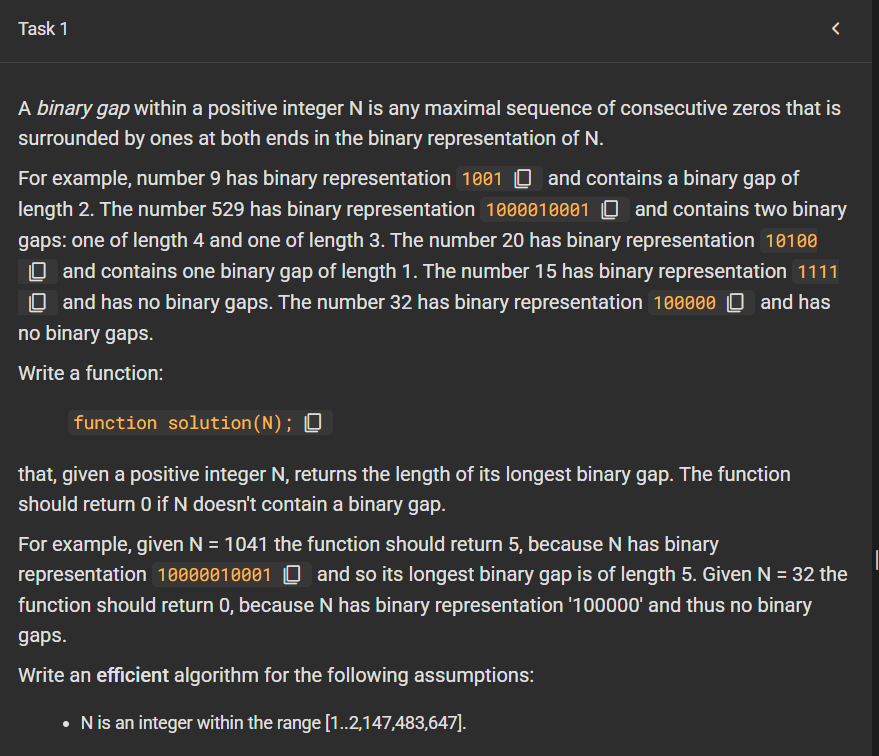
A binary gap within a positive integer N is any maximal sequence of consecutive zeros that is surrounded by ones at both ends in the binary representation of N. For example, number 9 has binary representation 1001 content_copy and contains a binary gap of length 2. The number 529 has binary representation 1000010001 content_copy and contains two binary gaps: one of length 4 and one of length 3. The number 20 has binary representation 10100 content_copy and contains one binary gap of length 1. The number 15 has binary representation 1111 content_copy and has no binary gaps. The number 32 has binary representation 100000 content_copy and has no binary gaps. Write a function: function solution(N); content_copy that, given a positive integer N, returns the length of its longest binary gap. The function should return 0 if N doesn’t contain a binary gap. For example, given N = 1041 the function should return 5, because N has binary representation 10000010001 content_copy and so its longest binary gap is of length 5. Given N = 32 the function should return 0, because N has binary representation ‘100000’ and thus no binary gaps. Write an efficient algorithm for the following assumptions: N is an integer within the range [1..2,147,483,647].
// you can write to stdout for debugging purposes, e.g.
// console.log('this is a debug message');

function solution(N) {
  const binary = N.toString(2);
  let maxGap = 0;
  let currentGap = 0;
  let counting = false;

  for (let char of binary) {
    if (char === "1") {
      if (counting) {
        maxGap = Math.max(maxGap, currentGap);
      }
      counting = true;
      currentGap = 0;
    } else if (counting) {
      currentGap++;
    }
  }

  return maxGap;
}
At first glance, a Fibonacci function seems like a simple coding exercise. You take a number n, and return the nth number in the Fibonacci sequence:
0, 1, 1, 2, 3, 5, 8, 13, 21…
Each number is the sum of the two before it.
Many beginners write Fibonacci using recursion because it feels natural. But while recursive code looks elegant, it can hide a major performance problem.
Senior software developers collaborate with business and quality analysts, designers, project managers and more to design software solutions that will create meaningful change for our clients. They listen thoughtfully to understand the context of a business problem and write clean and iterative code to deliver a powerful end result whilst consistently advocating for better engineering practices. By balancing strong opinions with a willingness to find the right answer, senior software developers bring integrity to technology, ensuring all voices are heard.
For a team to thrive, it needs collaboration and room for healthy, respectful debate. Senior developers are the technologists who cultivate this environment while driving teams toward delivering on an aspirational tech vision and acting as mentors for more junior-level consultants. You will leverage deep technical knowledge to solve complex business problems and proactively assess your team’s health, code quality and nonfunctional requirements.
You will learn and adopt best practices like writing clean and reusable code using TDD, pair programming and design patterns.
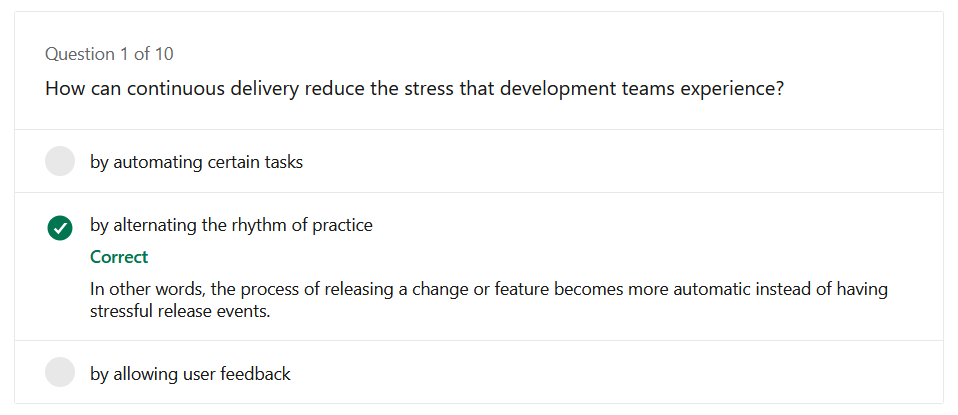
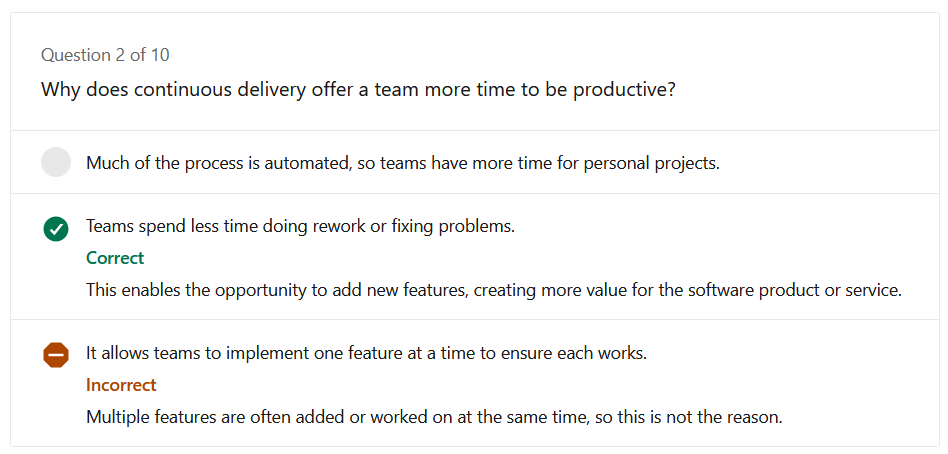
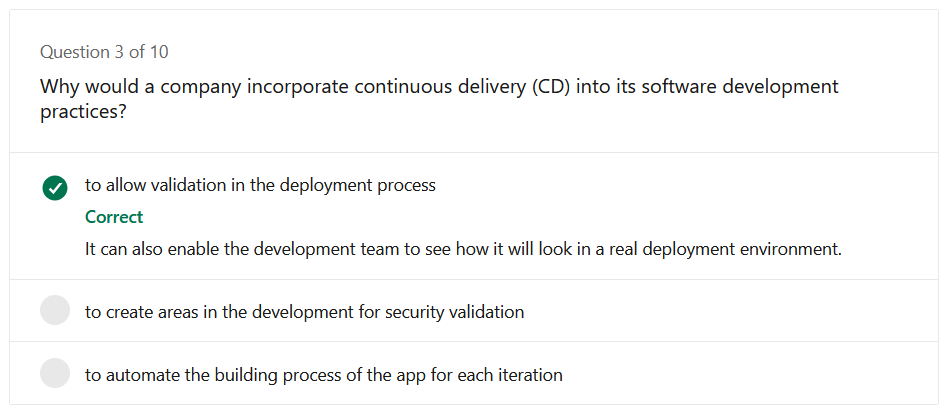
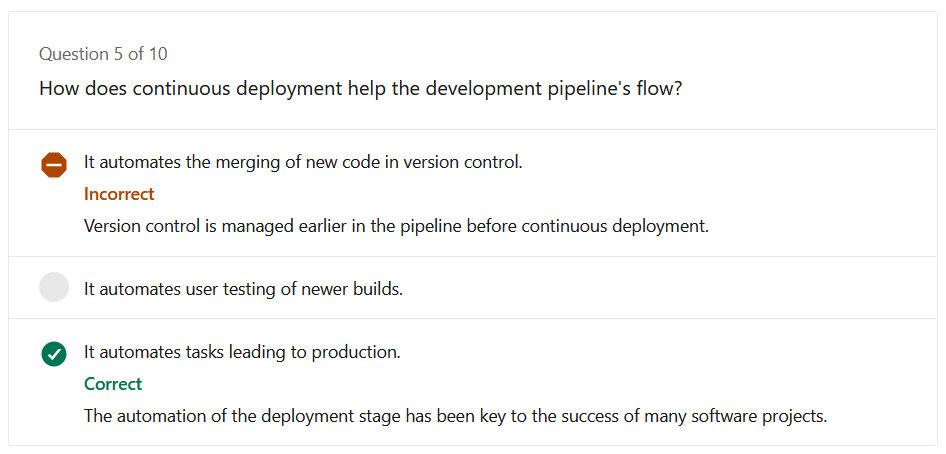
You will use and advocate for continuous delivery practices to deliver high-quality software as well as value to end customers as early as possible.
You will drive the AI-first software delivery strategy by strategically integrating and utilizing AI tools throughout the development lifecycle to enhance productivity, ensure high-quality code and create capacity for more complex and creative problem-solving.
You will work in collaborative, value-driven teams to build innovative customer experiences for our clients.
You will create large-scale distributed systems out of microservices.
You will collaborate with a variety of teammates to build features, design concepts and interactive prototypes and ensure best practices and UX specifications are embedded along the way.
You will efficiently utilize DevSecOps tools and practices to build and deploy software, advocating devops culture and shifting security left in development.
You will oversee or take part in the entire cycle of software consulting and delivery from ideation to deployment and everything in between.
You will act as a mentor for less-experienced peers through both your technical knowledge and leadership skills.
This means more than just years of experience. It usually implies the person can:
Own features or projects end-to-end
Make technical decisions independently
Mentor junior developers
Review code and improve team standards
Debug complex production issues
Balance speed, quality, and scalability
Communicate with product managers, designers, and stakeholders
Java
This refers mainly to backend development using Java. Typical responsibilities include: