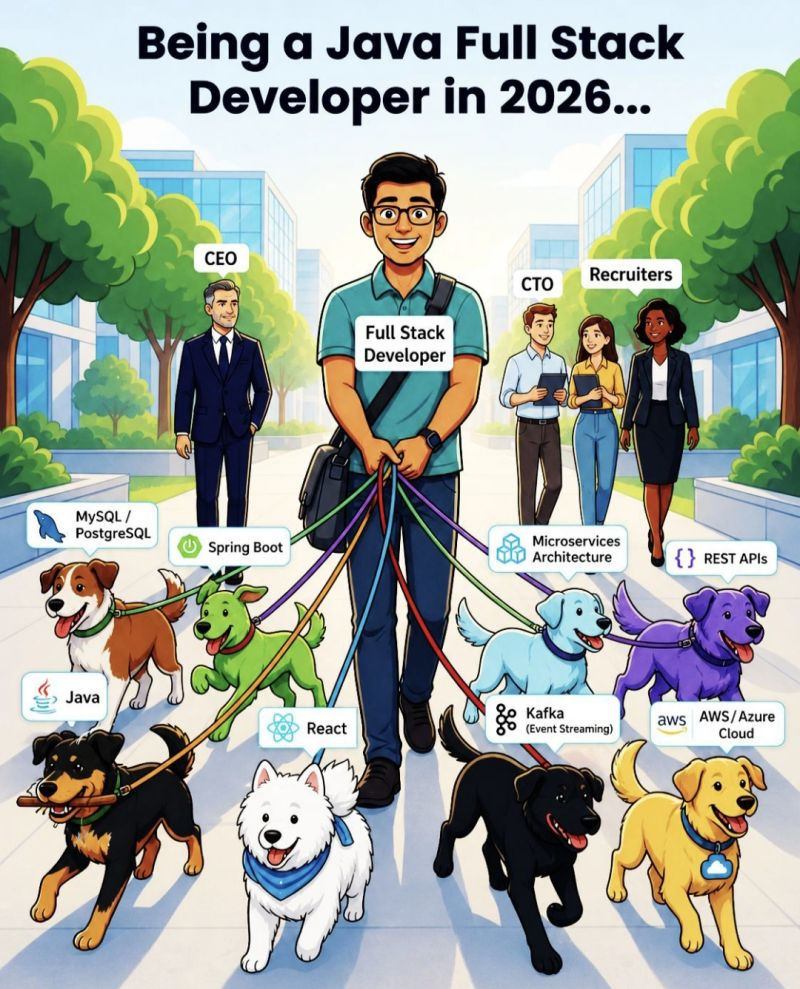
The role of a Java Full Stack Developer has changed dramatically over the last few years.
In the past, being a developer often meant focusing on a single layer of the application stack. Backend engineers stayed in backend systems. Frontend developers focused on UI components and browser behavior. Infrastructure was handled by separate operations teams.
That separation no longer exists in many modern engineering environments.
In 2026, a Java Full Stack Developer is expected to understand far more than just writing business logic or building web pages. The role has evolved into something much broader: orchestrating an entire ecosystem of technologies, services, workflows, and integrations.
The Backend Is Only the Beginning
Modern backend development still heavily revolves around Java and Spring Boot.
Developers are expected to design scalable REST APIs, build microservices, optimize database performance, implement authentication and authorization, and ensure systems remain resilient under heavy load.
But backend development today is not just about functionality.
It is also about architecture.
Questions like these are now part of daily engineering decisions:
- Should this service be event-driven?
- Is synchronous communication still the right approach?
- How should failures be handled across distributed systems?
- How do we scale efficiently without increasing operational complexity?
- What observability tools should be integrated from day one?
The complexity of backend engineering has increased significantly because applications themselves have become more distributed and interconnected.
Frontend Expectations Continue to Grow
At the same time, Full Stack Developers are also expected to deliver polished and responsive user experiences.
Frameworks like React and Angular are no longer “nice to have” skills. In many companies, they are baseline expectations.
Developers are now expected to understand:
- Component-based architecture
- State management
- API integration patterns
- Frontend performance optimization
- Authentication flows
- Accessibility and responsive design
- Real-time UI updates
The frontend is no longer treated as a simple presentation layer. It has become a sophisticated application environment on its own.
Then Comes Cloud and DevOps
Modern software systems do not stop at application development.
A Full Stack Developer in 2026 is also expected to understand deployment pipelines, cloud infrastructure, and operational reliability.
That means working with tools and platforms such as:
- AWS or Azure
- Docker and containerization
- Kubernetes orchestration
- CI/CD pipelines
- GitLab or Jenkins automation
- Infrastructure as Code
- Monitoring and logging systems
It is no longer enough to build software that works locally.
Applications must be scalable, observable, secure, and deployable across environments with minimal downtime.
The line between software engineering and platform engineering continues to blur.
Event-Driven Systems Add Another Layer
And then Kafka enters the architecture.
Message brokers and event-driven systems have fundamentally changed how enterprise applications communicate.
Instead of simple request-response flows, developers now work with asynchronous processing, event streaming, retries, dead-letter queues, and distributed event consistency.
This introduces a completely different way of thinking about application design.
Debugging becomes more challenging.
Tracing failures across systems becomes more complex.
Maintaining data consistency requires deeper architectural understanding.
But these patterns are also what enable modern systems to scale effectively.
Full Stack Developers Are Becoming System Thinkers
The biggest shift is not technological.
It is mental.
A modern Java Full Stack Developer is no longer just implementing features. They are constantly thinking about how multiple systems interact together.
They must understand:
- Backend architecture
- Frontend experience
- Infrastructure reliability
- Security considerations
- Deployment workflows
- Performance bottlenecks
- Scalability trade-offs
- System integration patterns
Every decision affects another layer of the system.
A small database change may impact API performance.
An API design decision may affect frontend responsiveness.
Infrastructure limitations may influence application architecture.
This interconnected thinking is what defines modern engineering expertise.
Why the Role Remains So Valuable
Yes, the role is demanding.
The pace of technology continues to accelerate.
New frameworks, tools, and platforms appear constantly.
But that is also what makes the role exciting.
Full Stack Developers today are involved in nearly every stage of software delivery, from architecture discussions to deployment automation to user experience optimization.
They are not simply writing code.
They are building systems that businesses and users depend on every day.
And in many ways, that is what makes being a Java Full Stack Developer in 2026 one of the most impactful roles in modern technology.