Most candidates fail interviews for one simple reason:
They know the answer in their head, but they deliver it in a messy, unstructured way.
One minute they’re talking about the problem, then suddenly jumping into technical details, then ending without explaining the actual result. Interviewers are left trying to connect the dots themselves.
This is where structured frameworks become incredibly powerful.
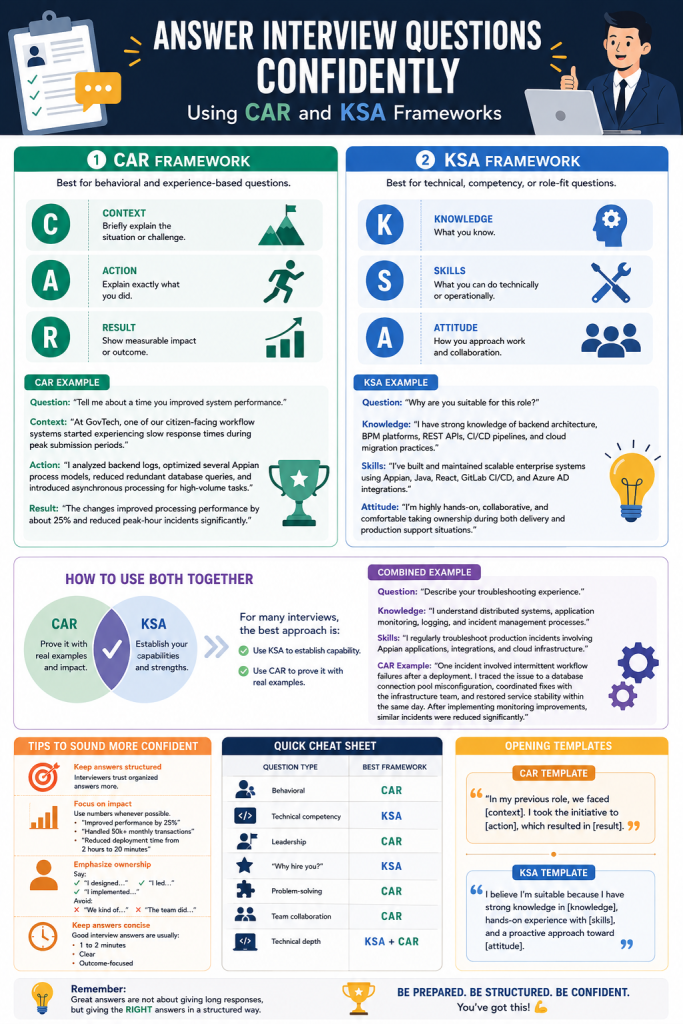
Two of the best frameworks I’ve used for technical and corporate interviews are:
- CAR Framework
- KSA Framework
These frameworks help you:
- Stay calm during interviews
- Structure answers clearly
- Sound more professional
- Demonstrate impact confidently
- Avoid rambling
Whether you’re interviewing for software engineering, DevOps, Appian, QA, SRE, or data roles, these frameworks work surprisingly well.
The CAR Framework
The CAR framework is ideal for behavioral and experience-based questions.
It stands for:
| Letter | Meaning |
|---|---|
| C | Context |
| A | Action |
| R | Result |
The beauty of CAR is that it forces your answer into a logical narrative.
1. Context
Start by explaining the situation briefly.
You are setting the stage for the interviewer.
Good context answers:
- What was the challenge?
- What system/project/team was involved?
- Why was it important?
Keep this part short.
Weak Example
“So we had this issue and people were discussing things and there were many problems…”
Strong Example
“At GovTech, one of our citizen-facing workflow systems began experiencing slow response times during peak submission periods.”
Clear. Specific. Professional.
2. Action
This is the most important section.
Explain:
- What YOU did
- Your technical contribution
- Your decision-making process
- Tools or technologies used
Avoid overusing “we.”
Interviewers want to know your contribution.
Weak Example
“We optimized the system.”
Strong Example
“I analyzed backend logs, optimized database queries, redesigned several Appian process flows, and implemented asynchronous processing for high-volume tasks.”
Now the interviewer can actually see your capability.
3. Result
Most candidates forget this part entirely.
Never end an answer without measurable impact.
Examples:
- Performance improvements
- Cost savings
- Reduced incidents
- Faster deployments
- Better user experience
- Increased scalability
Strong Result Statements
- “Improved system performance by 25%”
- “Reduced deployment time from 2 hours to 20 minutes”
- “Handled over 50k monthly transactions reliably”
Numbers make your story believable.
Full CAR Example
Interview Question
“Tell me about a time you solved a production issue.”
Answer
“At GovTech, one of our workflow systems experienced intermittent failures during peak traffic periods. I investigated application logs and traced the issue to inefficient database calls and thread contention within several backend services. I optimized the queries, adjusted thread pool configurations, and implemented monitoring alerts to detect recurrence early. As a result, system stability improved significantly and production incidents during peak periods were reduced.”
Notice how:
- The answer is structured
- It flows naturally
- It demonstrates ownership
- It ends with impact
That’s why CAR works.
The KSA Framework
KSA stands for:
| Letter | Meaning |
|---|---|
| K | Knowledge |
| S | Skills |
| A | Attitude |
This framework works best for:
- Technical competency questions
- “Why should we hire you?”
- Role-fit discussions
- Leadership and collaboration questions
1. Knowledge
This is what you understand conceptually.
Examples:
- Cloud architecture
- CI/CD practices
- Networking fundamentals
- BPM systems
- Distributed systems
- Data modeling
Example
“I have strong knowledge of backend architecture, REST APIs, CI/CD pipelines, and cloud migration practices.”
2. Skills
This is what you can actually do.
Examples:
- Build systems
- Troubleshoot production issues
- Automate deployments
- Write code
- Create dashboards
- Develop APIs
Example
“I’ve built scalable enterprise systems using Java, React, Appian, GitLab CI/CD, and Azure AD integrations.”
3. Attitude
This is the most underrated section.
Companies hire people they can trust under pressure.
Attitude includes:
- Ownership
- Collaboration
- Communication
- Learning mindset
- Reliability
Example
“I’m highly hands-on, proactive during incidents, and comfortable collaborating across engineering and business teams.”
Full KSA Example
Interview Question
“Why are you suitable for this role?”
Answer
“I believe I’m a strong fit because I have solid knowledge of backend systems, cloud infrastructure, and enterprise workflow platforms. I’ve built and maintained scalable applications using Appian, Java, React, and GitLab CI/CD pipelines. In terms of attitude, I’m highly collaborative, adaptable, and comfortable taking ownership of both delivery and production support responsibilities.”
Clean. Professional. Structured.
Combining CAR + KSA
The best interview answers often combine both frameworks.
Example Question
“Describe your troubleshooting experience.”
Combined Answer
“I have strong knowledge of distributed systems, application monitoring, and incident management practices. In my previous role, I regularly handled production troubleshooting across Appian applications and cloud infrastructure. One incident involved intermittent workflow failures after a deployment. I traced the issue to a database connection pool misconfiguration, coordinated fixes with the infrastructure team, and restored service stability within the same day. After implementing monitoring improvements, similar incidents were significantly reduced.”
This approach:
- Shows technical depth
- Demonstrates experience
- Proves real-world execution
Why These Frameworks Work So Well
Most interviewers are evaluating three things:
- Can you communicate clearly?
- Can you solve problems?
- Can you deliver impact?
CAR and KSA naturally answer all three.
They also help reduce nervousness because you already know the structure before answering.
Instead of improvising everything, your brain simply fills in the framework.
Common Interview Mistakes These Frameworks Prevent
1. Rambling
Without structure, candidates talk too much and lose focus.
2. Missing Results
Many people explain what they did but never explain why it mattered.
3. Weak Ownership
Saying “we” repeatedly makes your contribution unclear.
4. Sounding Unprepared
Structured answers automatically sound more professional.
Practical Tips for Better Interview Answers
Keep answers concise
Aim for:
- 1 to 2 minutes per answer
- Clear beginning, middle, and end
Use metrics whenever possible
Examples:
- 25% performance improvement
- 50k+ monthly transactions
- 40% faster deployment pipeline
- Reduced incidents by half
Metrics make you memorable.
Focus on YOUR contribution
Instead of:
“The team built…”
Say:
“I designed…”
“I implemented…”
“I led…”
Practice out loud
Reading answers silently is not enough.
The real challenge is verbal delivery.
Practice:
- Speaking slowly
- Structuring naturally
- Avoiding filler words
- Maintaining confidence
Final Thoughts
Technical knowledge alone is rarely enough to succeed in interviews.
The candidates who stand out are usually the ones who:
- Communicate clearly
- Structure answers well
- Demonstrate ownership
- Show measurable impact
Frameworks like CAR and KSA won’t magically get you hired.
But they dramatically improve how interviewers perceive your experience and confidence.
And in competitive tech interviews, that difference matters more than most people realize.