Every software engineer has seen some version of this image.
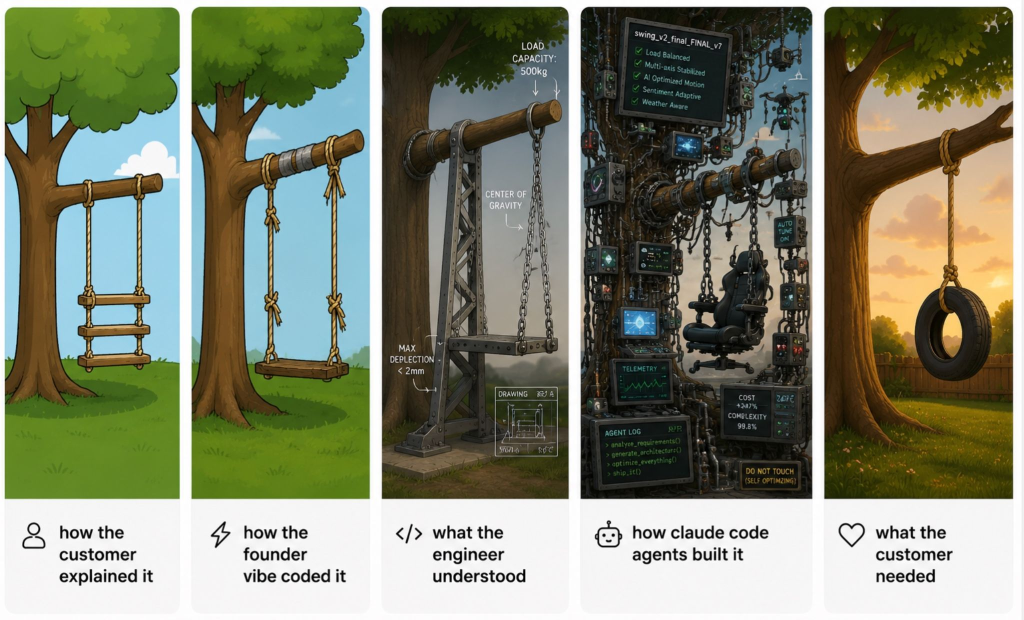
A customer wants a simple tire swing.
Somewhere between the first meeting and production deployment, it transforms into a distributed, AI-powered, telemetry-enabled, Kubernetes-compatible, blockchain-adjacent “platform solution” with 47 dashboards and a monthly cloud bill that could fund a small nation.
And somehow, the customer still just wanted the tire swing.
This meme is funny because it’s painfully real.
The Five Stages of Product Misalignment
1. How the Customer Explained It
The customer rarely speaks in technical language.
They talk about pain points:
- “I just want approvals to be faster.”
- “Can we reduce manual work?”
- “I need a dashboard.”
- “Customers are complaining.”
- “Our staff keep using Excel.”
What they mean is usually simple:
they want less friction.
But somewhere during requirement gathering, simplicity gets translated into ambiguity.
And ambiguity is where chaos begins.
2. How the Founder Vibe-Coded It
This is the startup phase.
No architecture diagrams.
No technical debt tracking.
No documentation.
Just pure adrenaline and caffeine.
Things get built quickly because:
- speed matters,
- investors want demos,
- users want features,
- and nobody wants to hear the phrase “we need another sprint.”
Ironically, this phase often creates products users actually love.
Why?
Because the team is still obsessing over solving the real problem instead of engineering perfection.
The downside:
eventually the duct tape starts showing.
3. What the Engineer Understood
This is where engineering culture kicks in.
A simple swing becomes:
- scalable,
- fault tolerant,
- event driven,
- horizontally expandable,
- microservice compatible,
- cloud native,
- AI enhanced,
- observable,
- resilient,
- and somehow still slower than the original prototype.
Engineers are trained to think ahead:
- “What if we get 10 million users?”
- “What about edge cases?”
- “Should we abstract this?”
- “Maybe we need a framework.”
And to be fair, these questions matter.
But sometimes we optimize for hypothetical futures instead of present reality.
The result?
We engineer for complexity before earning simplicity.
4. How AI Agents Built It
This panel feels especially relevant in 2026.
Today, AI coding agents can:
- generate APIs,
- scaffold infrastructure,
- write tests,
- deploy cloud resources,
- create dashboards,
- refactor code,
- and spin up entire applications in minutes.
Amazing productivity.
But there’s a hidden danger:
AI accelerates implementation faster than humans can validate intent.
If your requirements are vague, AI doesn’t reduce chaos.
It industrializes it.
You no longer get:
“Are you sure we need this?”
Instead, you get:
“Done. I also added monitoring, optimization, autoscaling, sentiment analysis, and predictive analytics.”
The future risk isn’t that AI will replace engineers.
It’s that AI will help organizations produce overengineered systems at unprecedented speed.
The Most Expensive Words in Tech
“Let’s make it flexible.”
Flexibility sounds responsible.
But uncontrolled flexibility creates:
- bloated systems,
- impossible maintenance,
- endless configuration,
- slow onboarding,
- fragile integrations,
- and products nobody fully understands anymore.
A shocking amount of enterprise software exists primarily to support edge cases that occur once every six months.
Meanwhile, the core user journey remains frustrating.
Why Simplicity Feels Hard
Simple systems look deceptively easy.
But true simplicity requires:
- clarity,
- restraint,
- prioritization,
- communication,
- and saying “no.”
That’s difficult in organizations where:
- every stakeholder wants features,
- every manager wants visibility,
- every engineer wants scalability,
- and every executive wants innovation.
Complexity accumulates naturally.
Simplicity must be defended intentionally.
The Best Engineers Aren’t the Ones Who Build the Most
They’re the ones who understand:
- what not to build,
- what can stay simple,
- what users actually care about,
- and when “good enough” is genuinely enough.
The best technical decisions often sound boring:
- fewer services,
- fewer frameworks,
- fewer dependencies,
- fewer meetings,
- fewer dashboards,
- fewer abstractions.
Not every application needs:
- AI,
- microservices,
- real-time streaming,
- Kubernetes,
- serverless architecture,
- or 12 observability platforms.
Sometimes the right answer is:
“Just build the tire swing.”
The Real Lesson
This meme isn’t really about software.
It’s about communication.
Every failed product usually breaks down somewhere between:
- what users need,
- what stakeholders imagine,
- what engineers optimize for,
- and what finally gets delivered.
Technology problems are often alignment problems wearing technical clothing.
The companies that win long term are rarely the ones with the most complicated systems.
They’re the ones that consistently solve real problems with the least unnecessary friction.
And sometimes, the smartest thing a team can do is stop adding features and ask:
“Are we still building the swing?”